Diesel hit $5.97 a gallon the week of September 7. That's the highest national average ever recorded. And every time fuel spikes, the phone lines light up with the same question: what can I bolt on, pour in, or plug into my truck to get better mileage?
Before you spend a dime on a gadget that promises five percent, look at the part of the truck that's worth a lot more than that. It's sitting in the driver's seat.
The industry's own maintenance council found as much as a 35% difference in fuel economy between the most and least efficient drivers. No additive on the market comes close to that. Last month I showed you how to build your true cost per mile. Fuel is the biggest piece of it. This month, let's shrink that piece without spending a penny.
Lever one: speed.
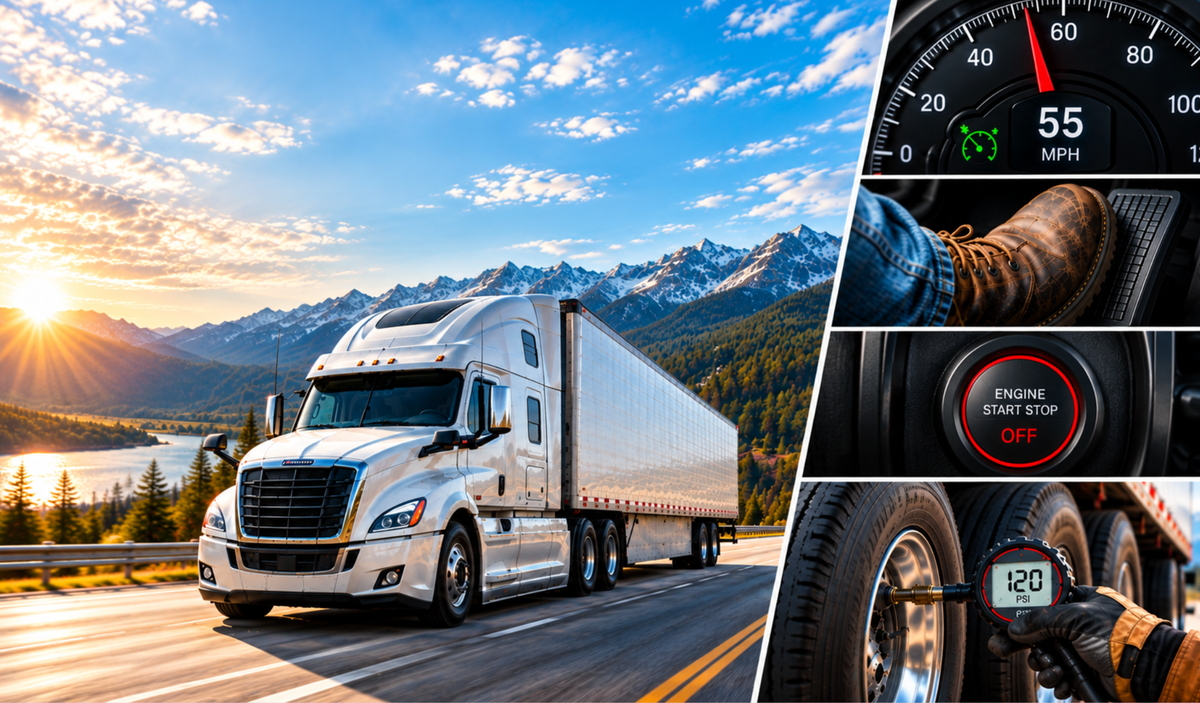
The rule of thumb in this industry is that every mile per hour above 55 costs you about a tenth of a mile per gallon. It sounds small. Run the numbers. Say your truck gets 6 miles per gallon at 70. Back it down to 65 and you're looking at something closer to 6.5. Over 100,000 miles, that's almost 1,300 fewer gallons. At today's price, that's around $7,600 a year. For lifting your foot five miles an hour.
I won't pretend it's free of trade-offs. You'll cover about five fewer miles for every hour you're at cruise, and if you're paid by the mile on a tight clock, that matters. That's exactly why you test it on your own truck instead of taking my word or anybody else's. It's also easier to stop a truck from 65 than from 70, and that's worth something too.
Lever two: idle time.
An idling truck burns roughly a gallon of fuel an hour. Research on long-haul trucks has put typical idling at around 6 hours a day. Even if you only idle 4 hours a night for 250 nights a year, that's about 1,000 gallons, or close to $6,000, spent going nowhere. And October is the easiest month of the year to fix it. The nights are cool, you don't need the air conditioning, and it's not cold enough to need the heat yet. A good sleeping bag and a cracked vent will do the job. Shut it down at the dock and in the fuel line too. Those minutes add up.
Lever three: your right foot.
I've always told drivers to drive like there's a raw egg between your boot and the pedal. Every hard launch and every late brake burns fuel you already paid for. Look far down the road. Ease off early and let momentum carry you into a slowdown instead of hammering the brakes and then hammering the throttle to get back up to speed. If you're running a manual, shift progressively, at the lowest RPM that gets the job done. If you're in an automated transmission, a light foot lets it upshift sooner. Either way, drive your gauges, not your ego.
Lever four: tire pressure.
Tires running 10 psi low can cost you somewhere between half a percent and a full percent of your fuel economy, and they wear out faster doing it. Checking them with a real gauge takes a few minutes and costs nothing. Most drivers only find out a tire's low when it's already a problem.
None of these are secrets. That's the point. The money isn't hiding in some new product. It's hiding in habits most drivers already know about and never measure.
And measuring is where this falls apart for most people. So here's the work this week. Hold a business meeting with yourself. Start tracking your fuel mileage by hand for the next three tanks: miles driven divided by gallons bought, written down every fill-up. Don't rely only on the number the dash shows you. Then pick one lever, just one, and run it hard for those three tanks. Most drivers start with speed because it moves the needle fastest. Compare the numbers and put a dollar figure on the difference. Every truck and every lane is different, and the only fuel economy number that matters is the one you proved on yours.
When you see what a half mile per gallon is worth in real dollars at today's price, you won't need anybody to tell you to keep doing it.
You're the kind of operator who runs the business instead of letting the fuel pump run it for you. Lift your foot, shut it down, check your tires, and write it down.
Be safe, be profitable, be responsible, and master the journey.